
What Is Agentic Project Management? Definition, Framework & Tools (2026 Guide)

Imagine a Monday status report that does not start with copying stale task data into a slide. The project manager opens the project, sees that an AI agent has already reviewed Friday's meeting notes, detected two new risks, drafted three action items, linked them to the launch goal, and prepared a status update. Nothing has been silently changed. The agent is waiting for approval.
That is what agentic project management delivers: not "AI writes prettier summaries," not "automation moves cards between columns." A real agentic PM system maintains the living project context that humans and AI agents both need to do useful work.
Agentic project management is the practice of managing projects with AI agents that can understand goals, maintain project context, plan next steps, execute bounded work, and update the project system as reality changes.
Project management is mostly a context problem. Teams do not fail because nobody has a kanban board. They fail because the board no longer matches the real project. A customer changed the requirement. A developer found a hidden dependency. The information exists somewhere, but it never became shared project truth.
Contents
- Short Definition
- Why This Category Matters in 2026
- Agentic PM vs. AI PM vs. Automation
- CDPM vs. Agentic PM vs. TensorPM
- The Core Principle
- The Agentic Project Management Framework
- How Agentic Project Management Works
- High-Value Use Cases
- What Not to Automate
- Risks and Failure Modes
- How to Evaluate an Agentic PM Tool
- A Practical Adoption Roadmap
- Where TensorPM Fits
- FAQ
Short Definition
As Simon Schwer, founder of TensorPM, defines it: "Agentic project management is a context-driven operating model where AI agents help plan, coordinate, execute, and update project work through a shared project graph, under explicit human oversight."
A system becomes agentic when it can do more than generate text. It needs to:
- Understand the project goal and constraints.
- Read structured project context.
- Break objectives into action items.
- Use tools or protocols to perform work.
- Ask for clarification when authority or context is missing.
- Propose project updates when new information changes the plan.
- Record what changed, why it changed, and who approved it.
In a mature setup, an agent does not merely answer, "What should we do next?" It can answer, "Here are the next three action items, here is the dependency I found, here is the decision record that explains why this matters, and here is the update I recommend applying to the project context."
That is the difference between a PM chatbot and an agentic project management system.
Why This Category Matters in 2026
AI agents are moving from novelty into enterprise software, but most project tools were designed for humans clicking through screens, not for agents working over long-running goals.
Gartner's August 2025 press release says that 40% of enterprise applications will be integrated with task-specific AI agents by the end of 2026, up from less than 5% in 2025. The same release frames AI assistants as a precursor to agentic AI and warns against "agentwashing."
At the same time, Gartner's September 2025 survey found that only 15% of IT application leaders were considering, piloting, or deploying fully autonomous AI agents. It also reported that only 13% strongly agreed they had the right governance structures to manage agents.
Project management sits directly in the middle of that tension. It is full of repetitive coordination work that agents can help with, but it also involves accountability, ambiguity, conflicting stakeholder interests, budget decisions, and incomplete data. That makes it a poor fit for blind autonomous project management and a strong fit for bounded agency.
The project management profession is already adopting AI. The Association for Project Management reported in September 2025 that 70% of surveyed project professionals said their organization currently used AI, compared with 36% in a comparable 2023 survey. PMI's 2023 report on the future of project management with AI is an older baseline, but still useful: it cited research showing that only about 20% of project managers had extensive or good practical AI experience.
So 2026 is not about whether AI enters project work. It already has. The real question is whether AI remains a collection of isolated assistants, or whether it becomes part of the project management system itself.
That is the opening for agentic project management.
Agentic PM vs. AI PM vs. Automation
Most confusion comes from using one word, "AI," for several different capability levels.
| Category | What it does | Typical example | Main limitation |
|---|---|---|---|
| Rule-based automation | Runs predefined workflows | "When status becomes done, notify Slack" | Cannot reason about new situations |
| AI assistant | Generates or summarizes content | "Write a project status update" | Depends on the user to provide context |
| PM copilot | Helps inside a PM tool | "Suggest risks from this plan" | Usually reactive and screen-bound |
| Agentic project management | Pursues bounded project goals with tools and memory | "Review new meeting notes, propose context updates, create action items, and assign one to Codex" | Requires governance, permissions, and high-quality context |
The distinction is not intelligence in the abstract. It is agency over project state.
If an AI writes a status report from data you paste into a prompt, it is an assistant. If it can inspect the project graph, identify stale assumptions, propose updates, create action items, route work to a coding agent, and record the decision trail after human approval, it is part of an agentic project management workflow.
The critical word is "bounded." Agentic PM should not mean an AI freely running the company. It means agents are allowed to act inside defined permissions, against explicit goals, with visible traces, and with human checkpoints for consequential changes.
CDPM vs. Agentic PM vs. TensorPM
These three ideas are related, but they are not the same thing:
| Layer | What it is | Role |
|---|---|---|
| CDPM | The methodology | Make project context the single source of truth |
| Agentic project management | The AI-native operating model | Let humans and agents work against that context |
| TensorPM | The reference platform | Store the graph, run the loop, expose it to agents |
Context-Driven Project Management is the underlying methodology: execution quality depends on context quality. It says the project should be managed from living context, not from disconnected documents.
Agentic project management is the AI-native operating model that implements that methodology. It asks: if AI agents are now part of the team, how do they read the project, take bounded action, and keep the project truth fresh?
TensorPM is one concrete platform for doing that. It gives humans and AI agents the same structured project graph, then exposes it through the desktop app, the built-in TensorPM agent, and agent interfaces such as MCP and A2A.
The Core Principle: Context Becomes Executable
Traditional project management treats context as documentation. You write a project charter, requirements document, risk register, roadmap, or decision log. These artifacts are useful, but they are usually passive. Someone has to remember to read them. Someone has to remember to update them. Someone has to notice when reality no longer matches them.
Agentic project management treats context as executable data.
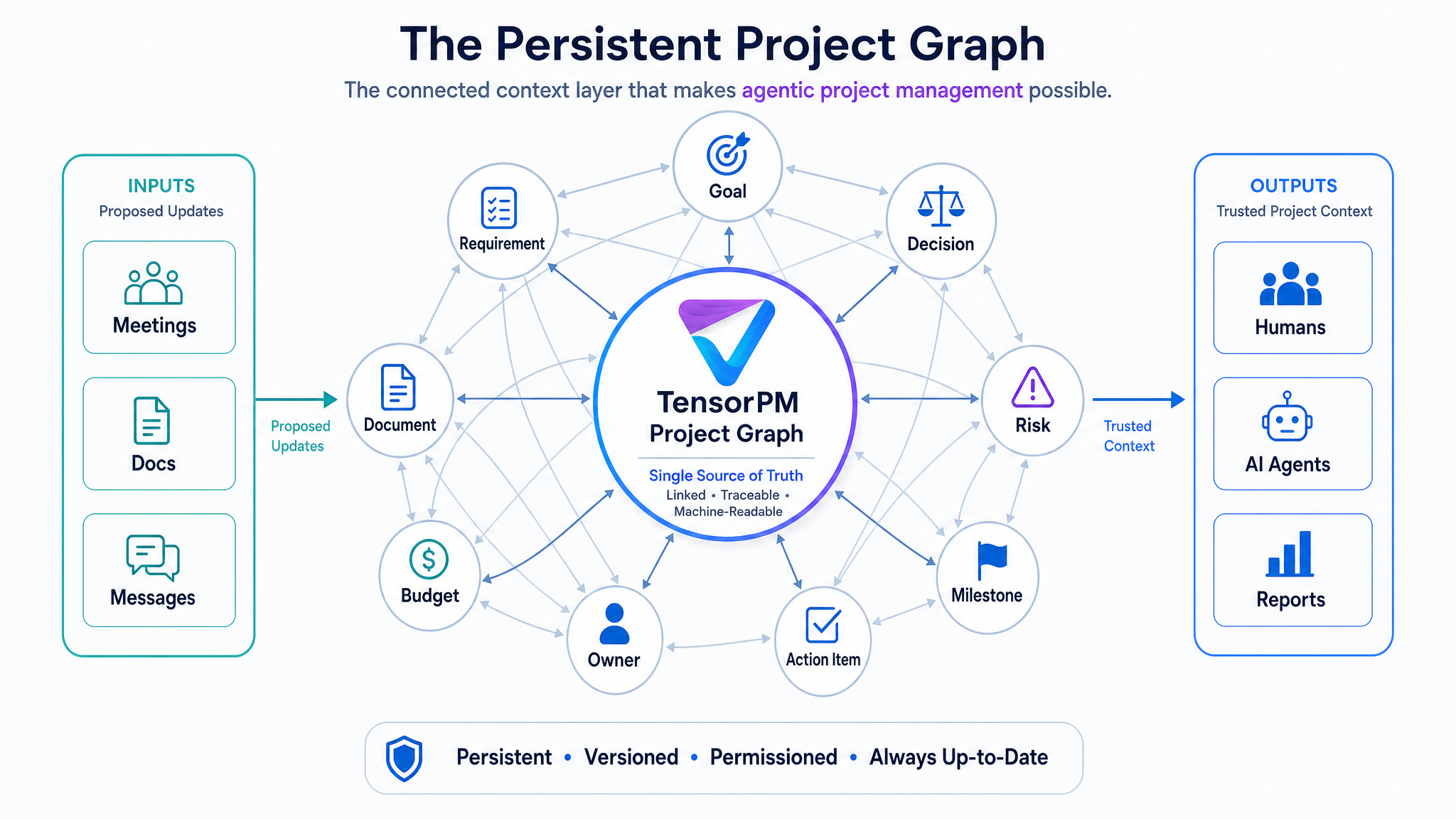
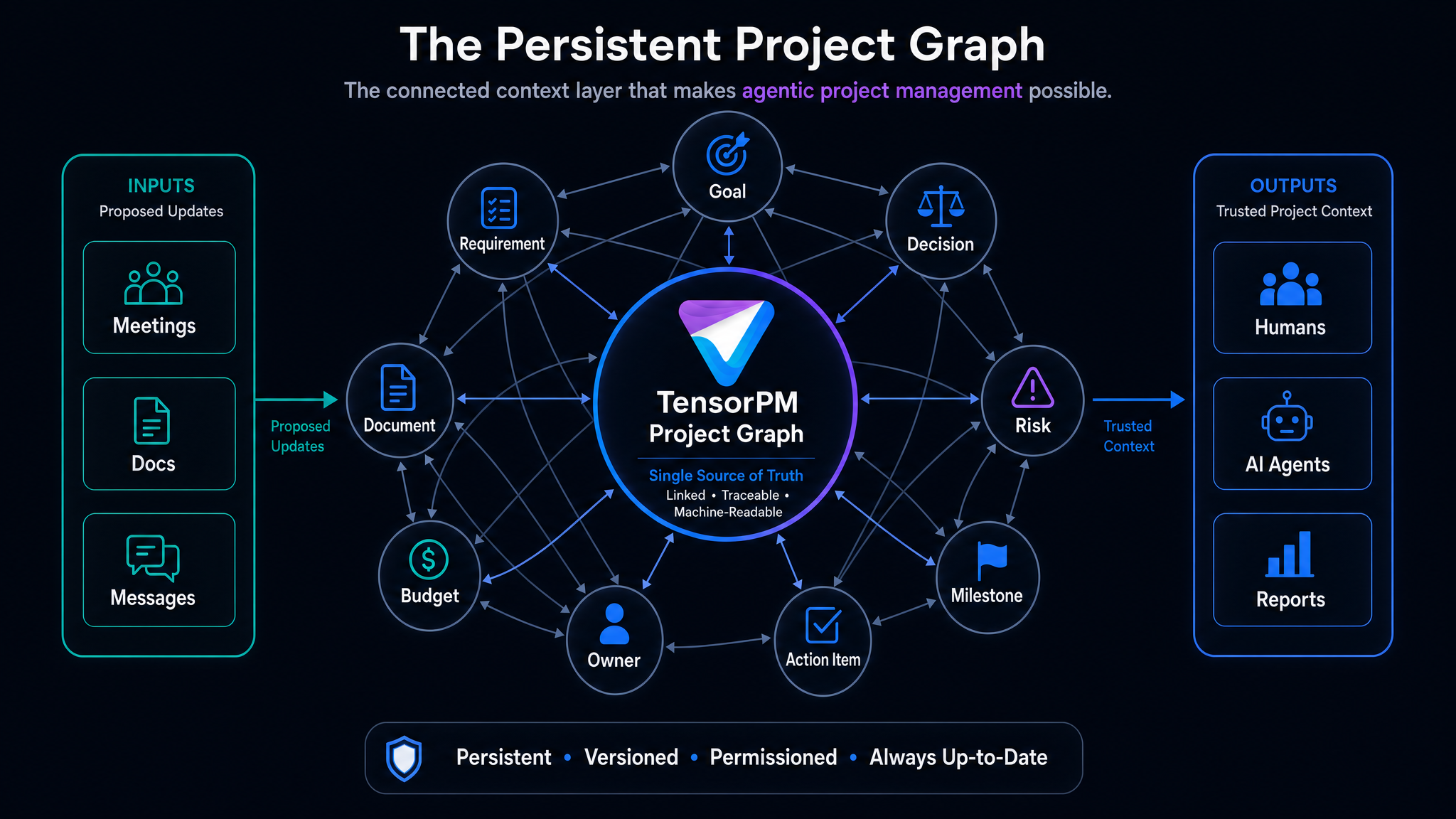
The project context is not just prose. It is a structured model of the project:
- Goals and success criteria.
- Scope and constraints.
- Requirements and assumptions.
- Action items and dependencies.
- Risks, mitigations, and owners.
- Decisions, rationale, and alternatives rejected.
- People, roles, budgets, timelines, and status history.
When this context is structured, agents can work with it. A coding agent can ask which requirement a task serves. A research agent can check whether a new source affects a risk. A PM agent can compare meeting notes against the current plan and propose a change. A human project manager can review the proposal instead of manually hunting through every artifact.
See agentic PM in action: Download TensorPM and try a local-first project graph for humans, project managers, and AI agents. It is free to use locally and works with your own AI keys.
The Agentic Project Management Framework
A real agentic project management framework needs more than a prompt box. Look for seven capabilities.
1. A Persistent Project Graph
Agents need durable memory outside the chat window. A transcript is not enough. The system needs structured, queryable project state: action items, goals, decisions, risks, owners, dependencies, and history.
This graph should survive model changes, context-window limits, app restarts, and agent handoffs. If the agent only remembers the current conversation, it is improvising.
2. Context Distillation
Projects generate raw signals: emails, meeting notes, chat threads, files, tickets, commits, and stakeholder comments. Most of those signals are noisy. Some of them change the project.
Context distillation is the process of turning raw signals into structured updates. For example:
- A meeting note becomes a new decision.
- A customer email becomes a changed requirement.
- A bug report becomes a risk.
- A revised estimate becomes a timeline update.
- A stakeholder comment becomes a clarification request.
The agent should not silently rewrite the project. It should propose precise changes that a human can approve, reject, or edit.
3. Planning and Decomposition
Agentic PM systems should break goals into executable work. That means creating action items with owners, dependencies, acceptance criteria, effort estimates, due dates, and links back to project goals.
The link back matters. A task linked to a goal, requirement, risk, or decision can be reasoned about by both humans and agents.
4. Tool Use
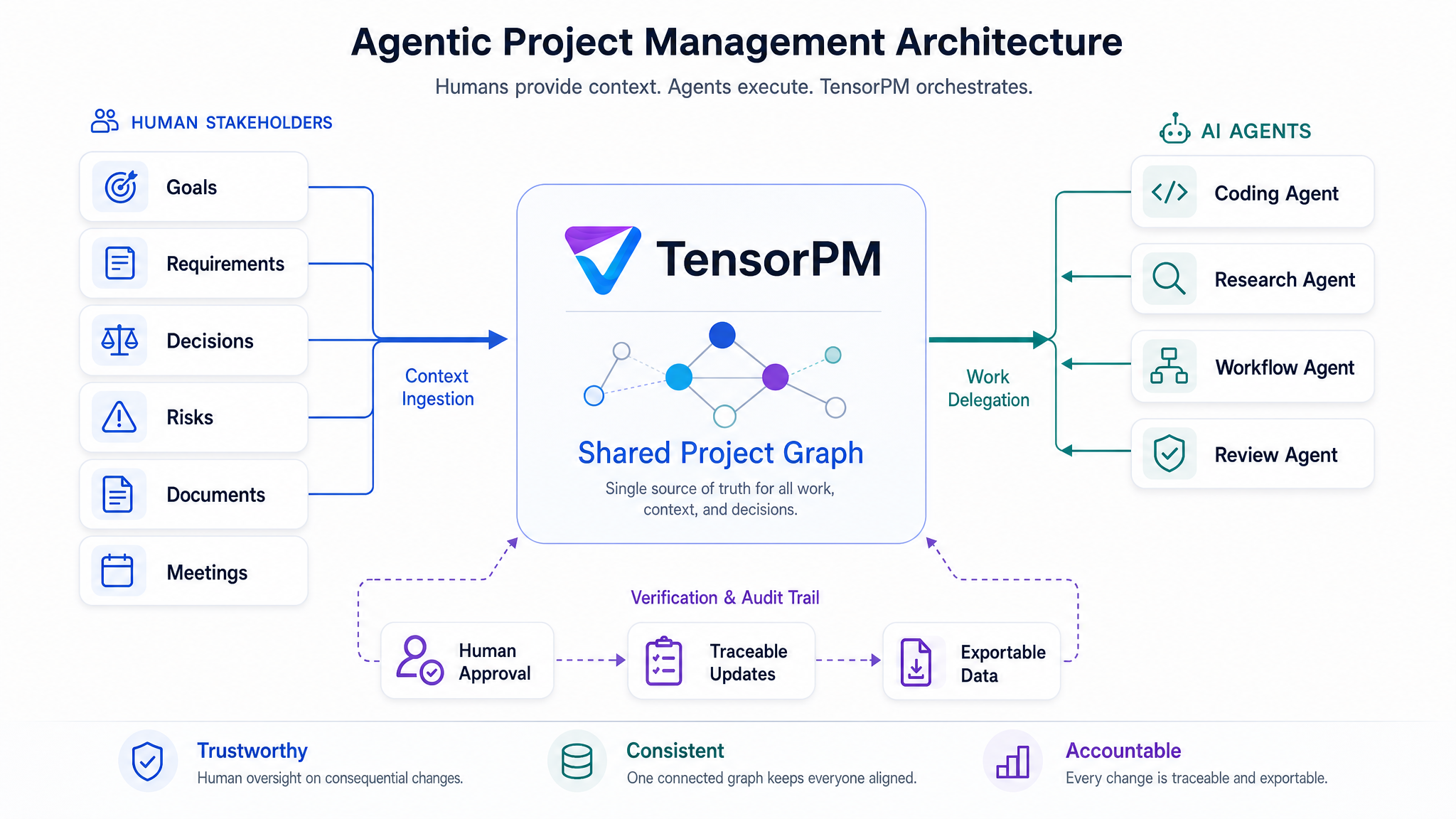
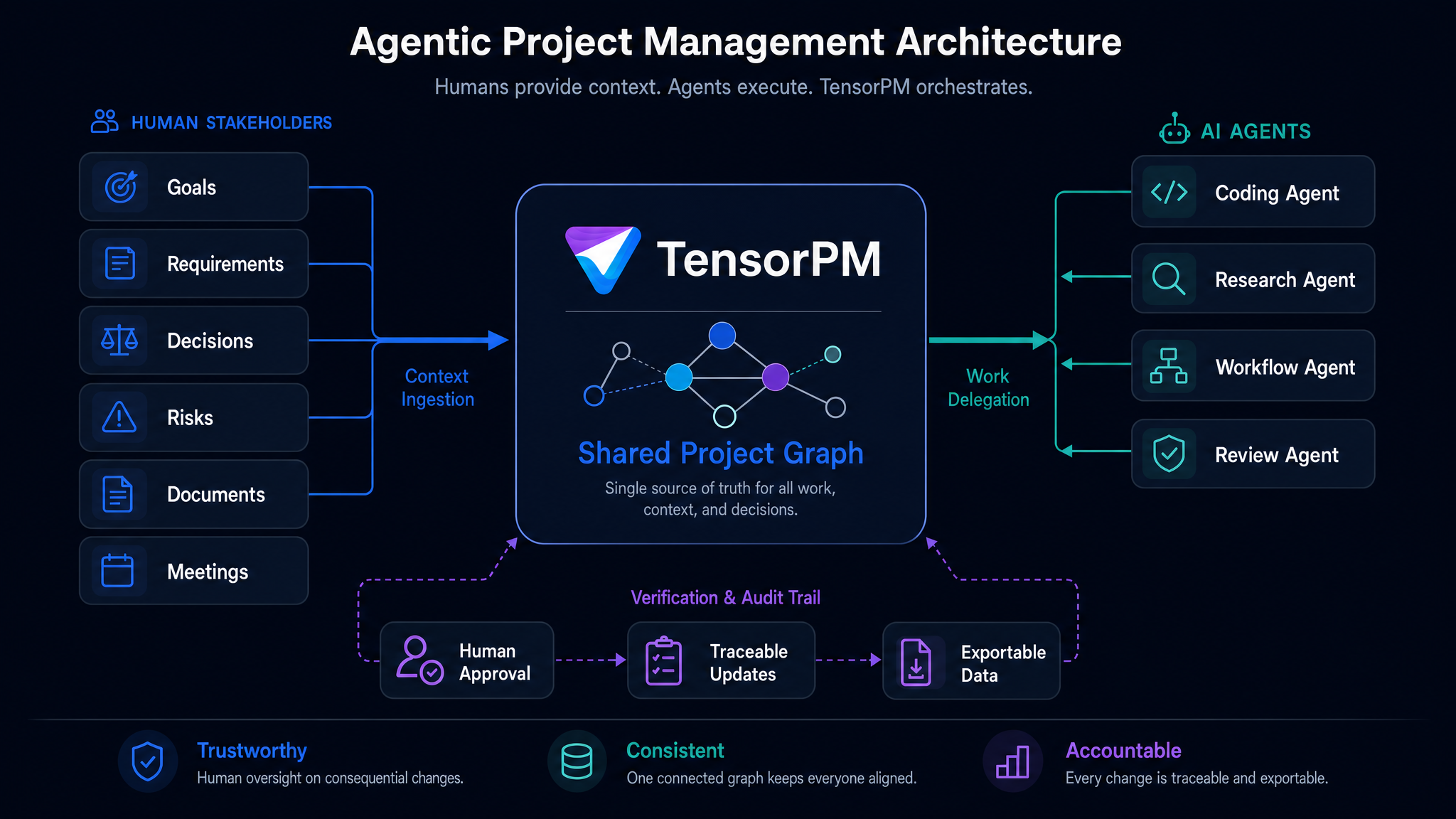
Agents become useful when they can act through tools. In project management, that can mean creating tasks, querying status, updating risk records, calling a coding agent, generating a project brief, or preparing a stakeholder update.
Open protocols are making this more practical. Anthropic introduced the Model Context Protocol as a standard for connecting AI systems to the places where data and tools live. The Agent2Agent protocol defines a way for independent agents to discover capabilities, exchange tasks, and collaborate without sharing internal state. For project work, MCP is about tool and context access; A2A is about agent-to-agent coordination.
5. Delegation
Agentic project management is not one giant agent. It is usually a network of specialized agents and human roles.
A PM agent may identify the work, a coding agent may implement it, a research agent may gather sources, and a human owner may approve scope or budget changes. The project system should keep all of that coordinated through one shared project graph.
6. Traceability
Every meaningful change should leave a trail:
- What changed?
- Why did it change?
- Which source triggered the change?
- Who approved it?
- Which tasks, risks, decisions, or goals are affected?
Without traceability, agentic PM becomes dangerous. It may look productive while quietly eroding accountability.
7. Human Authority
Autonomy does not remove accountability. It makes explicit governance more important.
An agent can propose a dependency change, draft a decision record, or assign work to another agent. A human or policy should approve changes that affect timeline, budget, scope, or authority.
The goal is not to remove the project manager. The goal is to remove the coordination drag that prevents the project manager from doing real project management.
How Agentic Project Management Works
A practical agentic workflow for project management looks like this:
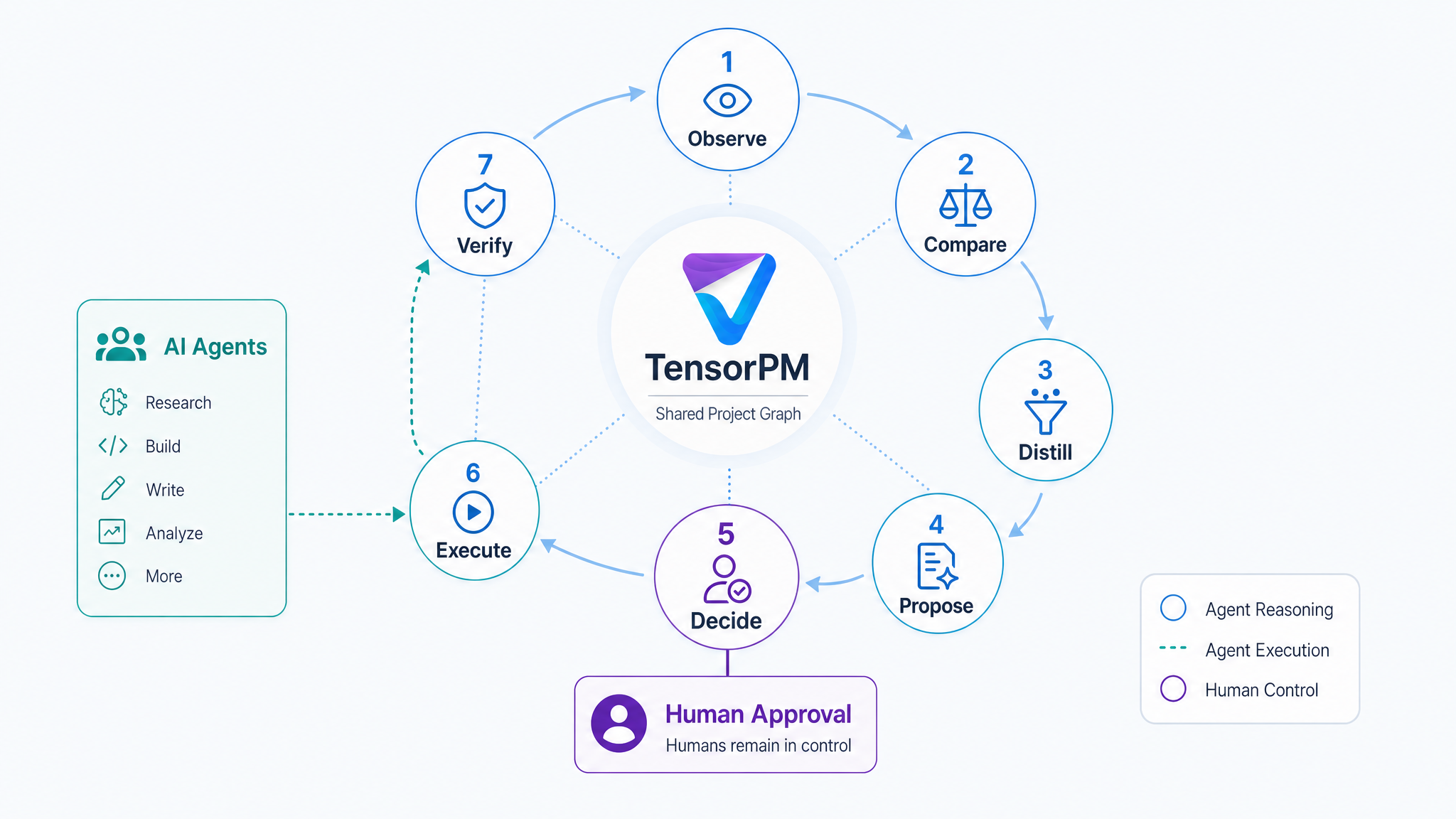
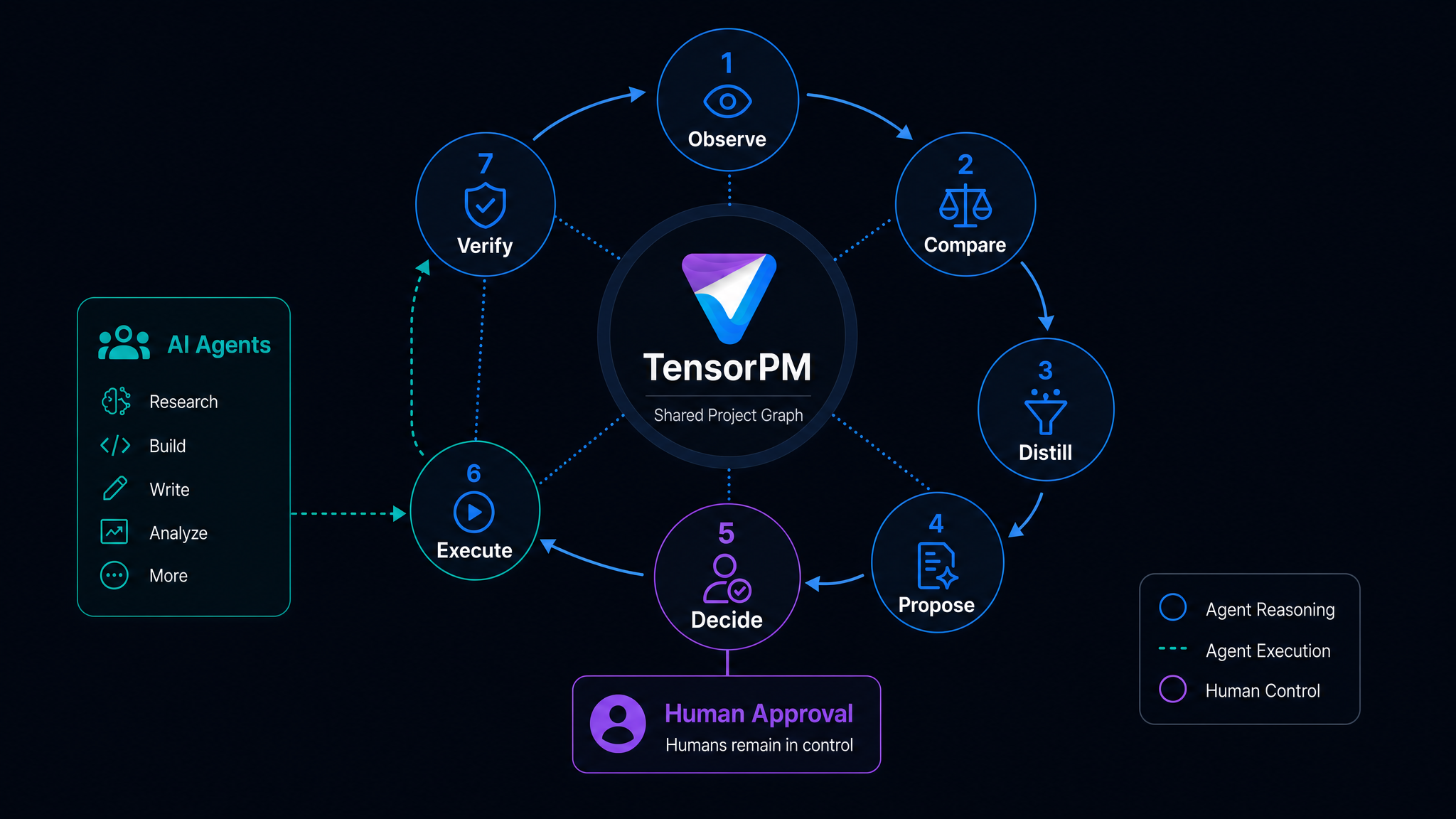
- Observe: The system receives a new signal, such as meeting notes, a document, a chat message, or a task update.
- Compare: An agent compares that signal against the current project context.
- Distill: The agent identifies whether the signal changes goals, requirements, risks, timeline, budget, action items, or decisions.
- Propose: The agent creates a concrete update proposal, ideally small enough to review quickly.
- Decide: A human accepts, edits, rejects, or asks for clarification.
- Execute: The system creates or updates action items, produces a concrete work artifact, or calls a specialized agent.
- Verify: The result is checked against acceptance criteria, and the project graph is updated again.
This loop is more important than any single AI model. A better model helps, but the operating model determines whether the project gets smarter over time or just produces more polished noise.
The best agentic PM systems are continuous context maintenance systems. They reduce the cost of keeping project truth fresh.
High-Value Use Cases
Agentic project management is strongest where coordination and context maintenance consume too much human attention.
Project Kickoff
Instead of starting with a blank canvas, an agent interviews the project owner, extracts goals, constraints, stakeholders, success criteria, known risks, timeline assumptions, and initial workstreams. The output is not just a summary. It becomes the initial project graph.
This is useful for founders, consultants, freelancers, internal teams, and agencies that begin projects from messy notes rather than clean requirements.
Action Item Generation
Agents can turn documents, emails, meeting notes, and project discussions into action items. The useful version is not "here are ten possible tasks." The useful version is "these four tasks are missing from the current plan, this one duplicates an existing item, and this one should be linked to the launch-readiness milestone."
Decision Capture
Decision logs often fail because nobody wants to maintain them. An agent can detect likely decisions from meeting notes or chat threads, draft a structured decision record, include rationale and rejected alternatives, and ask for confirmation.
Months later, agents and humans can answer "why did we choose this?" without searching through old conversations.
Risk and Dependency Monitoring
Agents can monitor incoming signals for risk changes. A delayed vendor email, a failed test, a new legal constraint, or an estimate change can trigger a proposed risk update or dependency warning.
The point is not that the agent predicts the future perfectly. The point is that it catches weak signals earlier than a monthly risk review.
Status Reporting
Most status reports are stale before they are read. An agentic workflow can generate reports from current project context, unresolved blockers, recent decisions, completed work, and changes since the last report.
The report becomes a view of the living project graph, not a writing exercise.
Cross-Agent Execution
Modern work increasingly involves specialized AI agents. Claude Code, Codex, Cursor, OpenClaw, and other tools can all perform different kinds of work. Agentic PM gives them a shared source of truth.
For example, a PM agent creates an implementation action item, links it to a requirement, assigns it to a coding agent, tracks the run, and records the outcome. The coding agent does not need the whole project re-explained. It asks the project graph for the relevant context.
Many teams search for an "AI agent for Jira" or an "AI agent for Linear" because they want this pattern inside existing tools. Atlassian's Rovo MCP Server documentation shows how quickly project systems are being exposed to external AI clients. That is useful, but the deeper question is whether the agent has enough project context to know what should happen next.
Agentic AI for Project Managers
The highest-value use case is giving project managers an AI counterpart that keeps the system current.
Agentic AI for project managers should behave like a disciplined project office assistant:
- It notices when reality changes.
- It drafts the update.
- It links the update to goals, risks, tasks, and decisions.
- It asks for approval before committing consequential changes.
- It gives every human and agent a fresher picture of the project.
That is a very different product philosophy from "ask a chatbot about your project."
What Not to Automate
Good agentic project management is selective. Some work is safe to automate. Some work should stay human-led.
| Work type | Agent role | Human role |
|---|---|---|
| Meeting summary | Draft and extract action items | Confirm what matters |
| Requirements update | Propose exact change | Approve scope impact |
| Risk detection | Surface weak signals | Decide mitigation |
| Task assignment | Recommend owner or agent | Confirm authority and priority |
| Budget change | Identify impact | Approve or reject |
| Stakeholder communication | Draft message | Send when sensitive |
| Strategic tradeoff | Prepare options | Decide |
The dividing line is accountability. If a change affects scope, budget, legal exposure, customer commitments, security, or people, the agent can prepare the decision but should not own it.
This is why "autonomous project management" is the wrong north star for most teams in 2026. The practical goal is governed autonomy: agents do useful work, humans keep authority over irreversible commitments.
Risks and Failure Modes
The biggest risk is not that the AI is useless. It is that it becomes useful enough to trust before governance is ready.
Agentwashing
Agentwashing means calling an ordinary AI assistant an agent because the market rewards the word "agent."
A generated status report is not an agent. A natural language filter is not an agent. A workflow automation with a nicer interface is not necessarily agentic.
Ask whether the system can act on structured project state, use tools, handle feedback loops, and record traceable changes. If not, it is probably an assistant.
Teams buy governance risk when they buy autonomy. If a tool cannot explain what changed, why, and under whose authority, it should not be marketed as agentic PM.
Stale Context at Machine Speed
An agent with stale context can make wrong work happen faster. It may create tasks from outdated requirements, summarize resolved risks as current, or assign work that no longer matters.
This is why agentic PM must start with context freshness. More integrations do not solve stale context if the connected sources are already wrong.
Permission Sprawl
Agents need access to tools, files, APIs, and other agents. Every permission expands the blast radius. Keep permissions narrow, log actions, separate read and write rights, and require approval for high-impact changes.
Gartner's 2025 survey found that only 13% of respondents strongly agreed they had the right governance structures to manage AI agents. That is the practical warning label for 2026 adoption.
Hallucinated Authority
Agents can sound confident when they do not know who has authority. A good system distinguishes between facts, assumptions, recommendations, and decisions.
If the agent cannot cite the source of a decision or identify who approved it, it should not present it as project truth.
Broken Handoffs
Multi-agent workflows fail when context does not travel with the work. A coding agent gets a vague task. A research agent returns useful findings that never update the plan. A PM agent creates action items nobody sees.
The fix is not longer prompts. The fix is shared structured context and explicit handoff records.
How to Evaluate an Agentic PM Tool
Use these questions when evaluating agentic project management tools:
- Does it maintain a persistent project graph, or only chat history?
- Can agents read and write structured project objects?
- Are goals, requirements, decisions, risks, and action items linked?
- Can the system ingest signals from email, documents, websites, meetings, chats, tickets, and files, then propose structured context updates?
- Does human approval act as the quality and consistency gate for consequential changes?
- Does every update have a trail?
- Can external agents access the same context through MCP, A2A, or an equivalent interface?
- Can the PM agent execute or delegate work to connected agents, such as coding, web research, and workflow agents, as well as humans?
- Are permissions scoped by role, tool, and action type?
- Can you bring your own model or run locally if privacy requires it?
- Does the tool work when the model changes?
- Can you export your project data?
If the answer to most of these is no, you are probably looking at an AI-enhanced PM tool, not agentic project management.
Agentic PM self-check: Use the Agentic PM Evaluation Checklist when reviewing tools. TensorPM is built around the same criteria: persistent project graph, human approval, traceable updates, MCP/A2A access, local-first storage, and agent-ready action items. Start with the checklist, then compare TensorPM with Asana or download TensorPM.
A Practical Adoption Roadmap
You do not need to automate everything at once. In fact, you should not.
First 30 Days: Make Context Explicit
Start by defining the project graph. Capture goals, scope, success criteria, stakeholders, risks, decisions, action items, dependencies, and budget assumptions in one place.
Then audit freshness. Which documents are current? Which decisions are undocumented? Which risks are still open only because nobody updated the register?
Do not begin with autonomy. Begin with truth.
Days 31-60: Add Context Distillation
Feed the system project signals: meeting notes, files, messages, customer emails, and task updates. Let the agent propose changes. Keep human approval mandatory.
Measure review friction. If approving a useful update takes less than a minute, the system will be used. If it takes ten minutes, people will skip it.
Days 61-90: Delegate Bounded Work
Once context is trustworthy, delegate low-risk work:
- Draft status reports.
- Generate action items from notes.
- Prepare meeting agendas.
- Update decision records.
- Assign technical tasks to coding agents with clear acceptance criteria.
Keep budget, scope, and strategic commitments human-approved.
After 90 Days: Expand the Agent Network
Add specialized agents where they clearly reduce coordination drag. A coding agent can execute implementation tasks. A research agent can monitor external changes. A PM agent can maintain project context. A human project manager remains the accountable orchestrator.
At this point, the project management system becomes an agentic operating layer rather than a passive task database.
Where TensorPM Fits
TensorPM is built around the premise that AI agents need project context, not just prompts.
It provides a local-first project graph for humans and agents: goals, action items, decisions, history, risks, budgets, timelines, and project context in one structured system. The built-in TensorPM agent distills signals into proposed context changes, analyzes project status, and provides guidance on priorities and next steps. Humans stay in control through review and approval.
Execution extends that steering layer. TensorPM can create and revise Word documents, PDF reports, and presentations in project context. Technical action items can be assigned directly to Codex or Claude Code, followed interactively or headlessly, and then reconciled with the project.
For external agents, TensorPM exposes the same project graph through MCP and A2A. Claude Desktop, Codex, Claude Code, Cursor, and other compatible agents can ask for project context instead of guessing, perform typed work, and return governed updates.
That makes TensorPM different from a classical task tracker. Other tools store tasks. TensorPM is designed to store evolving project intent.
Useful next steps:
- Learn the methodology behind it: Context-Driven Project Management.
- Compare the approach with a mainstream work management tool: TensorPM vs Asana.
- Connect agents through the project graph: TensorPM Skill.
- Explore the agent-facing setup: TensorPM for Agents.
- See why collaboration needs a shared work object: Codex, Claude and Co.: The Wrong Approach.
- Install the app: Download TensorPM.
FAQ
What is agentic project management in simple terms?
Agentic project management means using AI agents to help manage a project as an active system. The agent can read project context, propose updates, create or route work, monitor changes, and keep a decision trail, while humans remain accountable for important decisions.
How is agentic project management different from AI project management?
AI project management is broad. It can include summaries, forecasting, chatbots, or task suggestions. Agentic project management is narrower and more operational: agents act on structured project state, use tools, follow feedback loops, and update the project system under governance.
Will agentic project management replace project managers?
No. It changes the project manager's work. The agent can reduce coordination overhead, draft updates, detect stale context, and route work. The project manager still owns judgment, tradeoffs, stakeholder alignment, escalation, scope, budget, and accountability.
What is the biggest requirement for agentic PM?
Fresh, structured project context. Without it, agents operate on stale assumptions. A task list alone is not enough. The system needs goals, decisions, requirements, risks, dependencies, ownership, and history in a form agents can query and update.
Is agentic project management safe?
It can be, if it is designed with scoped permissions, approval gates, traceability, and privacy controls. It is unsafe when agents get broad write access, unclear authority, no audit trail, or stale context.
What should teams automate first?
Start with low-risk, high-friction work: meeting summaries, action item extraction, status report drafts, decision log proposals, and risk signal detection. Do not start with autonomous budget, scope, or customer commitment changes.
Do I need MCP or A2A for agentic project management?
Not always, but open protocols help. MCP is useful for giving agents structured access to tools and data. A2A is useful when multiple agents need to collaborate or delegate work across systems. A strong agentic PM platform should have a clear integration story for both.
Sources and Further Reading
- Gartner: 40% of enterprise apps will feature task-specific AI agents by 2026
- Gartner: only 15% of IT application leaders are considering, piloting, or deploying fully autonomous AI agents
- Association for Project Management: AI use in project management nearly doubled in two years
- PMI: Shaping the Future of Project Management With AI
- Anthropic: Introducing the Model Context Protocol
- Agent2Agent Protocol Specification
- OpenAI: The next evolution of the Agents SDK
- Atlassian: Getting started with the Atlassian Rovo MCP Server
- McKinsey: Seizing the agentic AI advantage
- IJCAI 2024: Large Language Model Based Multi-agents: A Survey of Progress and Challenges
Final Takeaway
Agentic project management is not a feature checklist. It is a shift in how projects are represented and operated.
The old model says: humans keep the project context in documents, and tools display the work.
The new model says: the project context is a living graph, humans and agents both work against it, and every change feeds the next decision.
That is the category forming in 2026. The winners will not be the tools with the loudest AI button. They will be the systems that make project truth fresh, structured, traceable, and usable by both humans and agents.
Corrections
No corrections to date.