
When Hierarchy Beats Expertise: The High Cost of Missing Context

Imagine your Lead Developer asks for a license for a better AI tool. Cost: $30 a month. The CEO looks at the number, compares it with the basic version for $10, and decides immediately: "We need to save money. The $10 version is good enough."
In that moment, the company just burned hundreds of dollars.
Why? Because the CEO only sees the $20 saving on their cost center. What they don't see: The "expensive" version would have saved the developer 30 minutes of work every day. At an hourly rate of $100, this false frugality costs the company $50 in lost productivity every single day.
This phenomenon, where decisions are made based on hierarchy rather than expertise, is often called the HiPPO Effect (Highest Paid Person's Opinion). But the real problem is often not arrogance. The problem is that every person involved lives in their own, limited reality.
The Blind Men and the Project Elephant
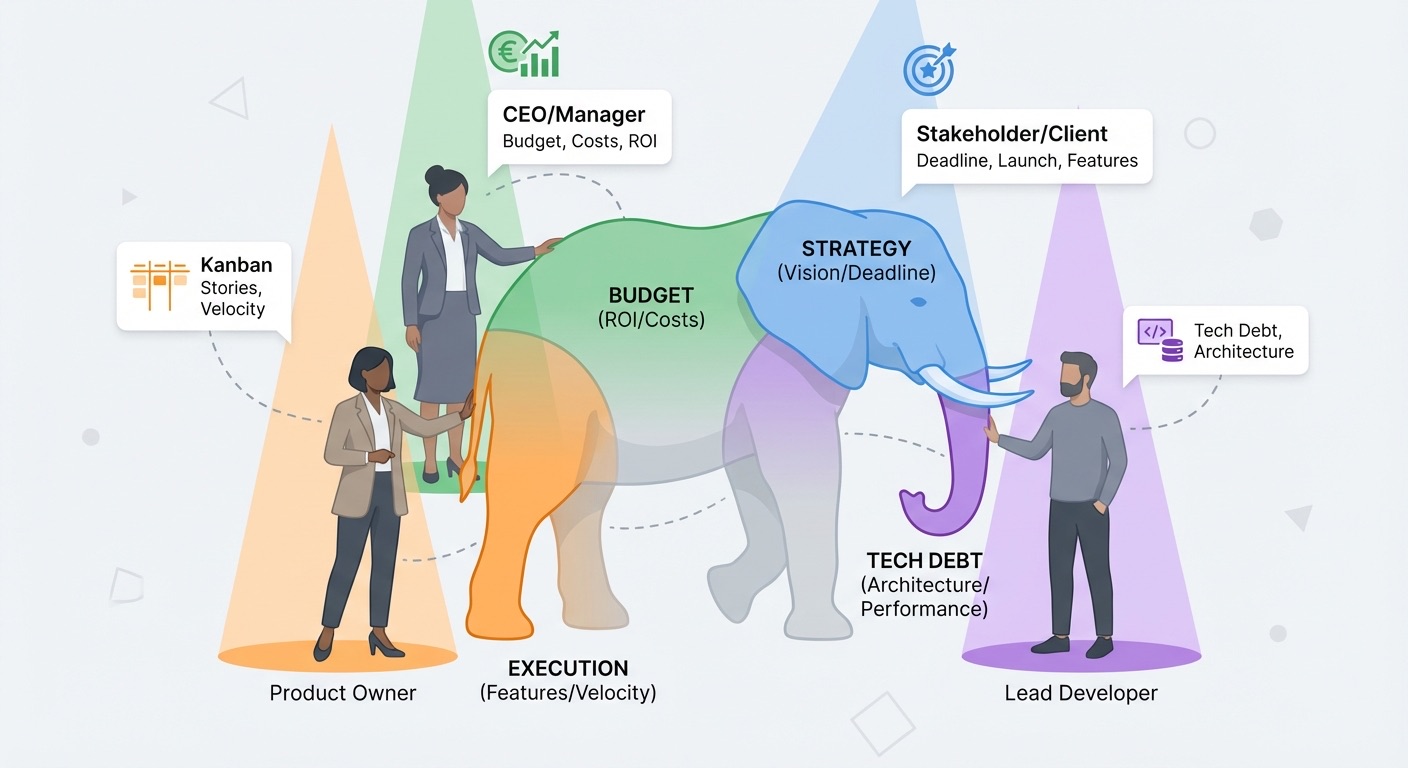 Like the parable of the blind men: The CEO only sees costs, the developer only sees tech, the PO only sees features – nobody sees the whole project.
Like the old parable of the blind men examining an elephant, each person sees only a tiny slice of the project. And everyone optimizes ruthlessly for that slice—often at the expense of the big picture.
The Product Owner in the "Feature Tunnel"
Take the Product Owner. Their context is the backlog. They want their team to be busy and delivering features. Whether the budget for this is actually exhausted is secondary ("As long as the resources are there"). Often, this leads to features being built that are technically feasible and keep the team occupied, but don't necessarily contribute to the strategic business goal. "Output" is produced instead of "Outcome."
The Manager and the Cost Trap
On the other side sits the Manager or CEO. Their context is financial performance. They primarily see the cost center and want to save. This often leads to fatal decisions where features are cut that would actually have a superior long-term value, simply because they cost money upfront.
Why Meetings Don't Solve the Problem
You might think you just need to lock these people in a room and let them talk. But in meetings, these isolated contexts just clash.
- The PO argues with "User Value."
- The Manager argues with "Budget."
- The Lead Developer argues with "Technical Debt."
There is no common currency, no "Single Source of Truth" that connects these perspectives. And when arguments stand against arguments, the HiPPO wins in the end.
The Missing Map: Anatomy of a Shared Context
Imagine you are navigating. The Manager has a map marked with dollar signs. The Developer has a map of server architectures. But no one has the map that shows how the fuel (money) relates to the destination (product success).
A "Shared Context" isn't just an abstract cloud of information; it is a hard link between data points. In Context Driven Project Management (CDPM), a decision chain looks like this:
- Strategy: "Achieve Market Leadership in Mobile Performance"
- Goal: "Reduce App Load Time to under 200ms"
- Requirement: "License new Caching Framework"
- Cost: "$30 / month"
When the CEO says "$30 is too much," they instantly see a red warning light: Goal 'Load Time' Endangered. They are no longer just cutting an isolated cost item; they are actively deciding against a strategic goal. This massive shift in perspective changes the psychological barrier for cutting costs and forces a discussion about value, not price.
How TensorPM Democratizes Context
This is where TensorPM comes in and introduces a new approach: Context Driven Project Management (CDPM).
We believe that good decisions can only be made based on radical transparency and a shared, complete context. This context brings clarity to everyone involved and is the prerequisite for AI to deliver its maximum value.
In TensorPM, these worlds can be considered within the same confirmed project context:
- Goals Meet Work: Goals, requirements, decisions, and action items do not live in separate files. Project analysis can surface missing goal coverage and strategic gaps.
- Costs Meet Consequences: Budgets, resources, timelines, and dependencies are part of the same project picture. A cut can be assessed as an option with affected goals, tasks, and risks instead of an isolated number.
Why Context is the Fuel for AI
Everyone talks about AI in project management. But AI suffers from the same problem as an external consultant: Lack of context. If you feed an LLM only your backlog, it will help you write tickets faster. If you feed it only your financial sheets, it will suggest cost cuts. It remains trapped in the silos.
In TensorPM, shared context grounds the AI. It can compare the $360 saving with documented dependencies, capacity assumptions, and project goals, and state clearly which assumption is still missing. It should not invent a deceptively precise success probability. AI provides a reasoned analysis and options; the people involved make the decision and remain accountable.
Data Beats Rank
When this context is visible to everyone, the discussion changes. You no longer have to contradict the boss ("I think that's wrong"). You point to the system:
"Boss, we can take the small license. But the system shows that we are endangering the 'Release Speed' goal because developer capacity will drop. Do we want to adjust the goal or the license?"
Suddenly, it is a visible, jointly reviewable trade-off rather than a pure power struggle.
Conclusion: Break Out of the Silos
As long as team members are trapped in their isolated contexts—the PO in the backlog, the boss in the spreadsheet—projects will suffer from unrealistic expectations and false economies.
The key to success is not to shout louder at the boss, but to tear down the walls between these contexts. With TensorPM, we create a reality that everyone can see. And in that reality, the best idea wins in the end, not the highest salary.
Ready to defeat the HiPPO effect? Stop letting isolated metrics dictate your project's success. Start building your shared context with TensorPM today.
Read next: What Is Agentic Project Management? Definition, Framework & Tools (2026 Guide) — the shared context that ends boardroom power plays is the same context AI agents need to plan, propose updates, and execute work without guessing. That's the operating model the pillar piece walks through end-to-end.
About the Author
Simon Schwer is a Project Manager with years of expertise from numerous international projects. He knows the challenges of unstructured projects firsthand and is developing TensorPM to combine structure and AI to lead project teams to success.
Corrections
No corrections to date.