
AI Agents for Project Management 2026: A Practical Comparison

"AI agent" is one of the most overused terms in project management in 2026. Many tools now use the label broadly, from kanban add-ons to meeting-note bots. Most comparison articles stop at the feature checklist: chat, skills, browser control, integrations. That is not enough to choose the right system.
TensorPM, OpenClaw, the Hermes Agent by Nous Research, Pi, and DeepSeek Harness represent five different agent paradigms. The useful distinction is not which feature list is longest. It is which layer of project work each system covers.
OpenClaw and Hermes organize operational work. Pi and DeepSeek Harness provide the technical agent runtime. TensorPM asks which work moves the project forward and what it means for timeline, budget, and scope.
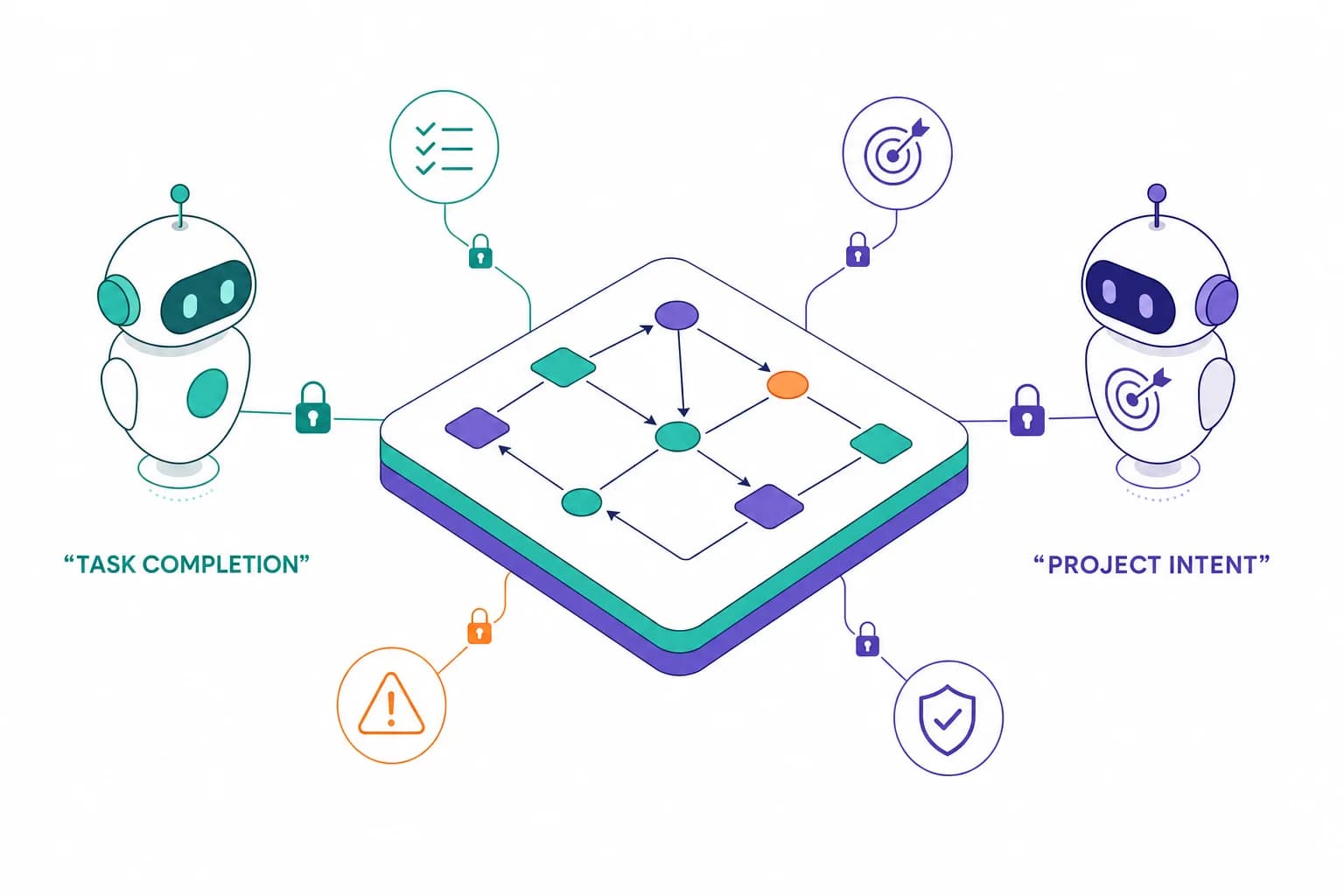
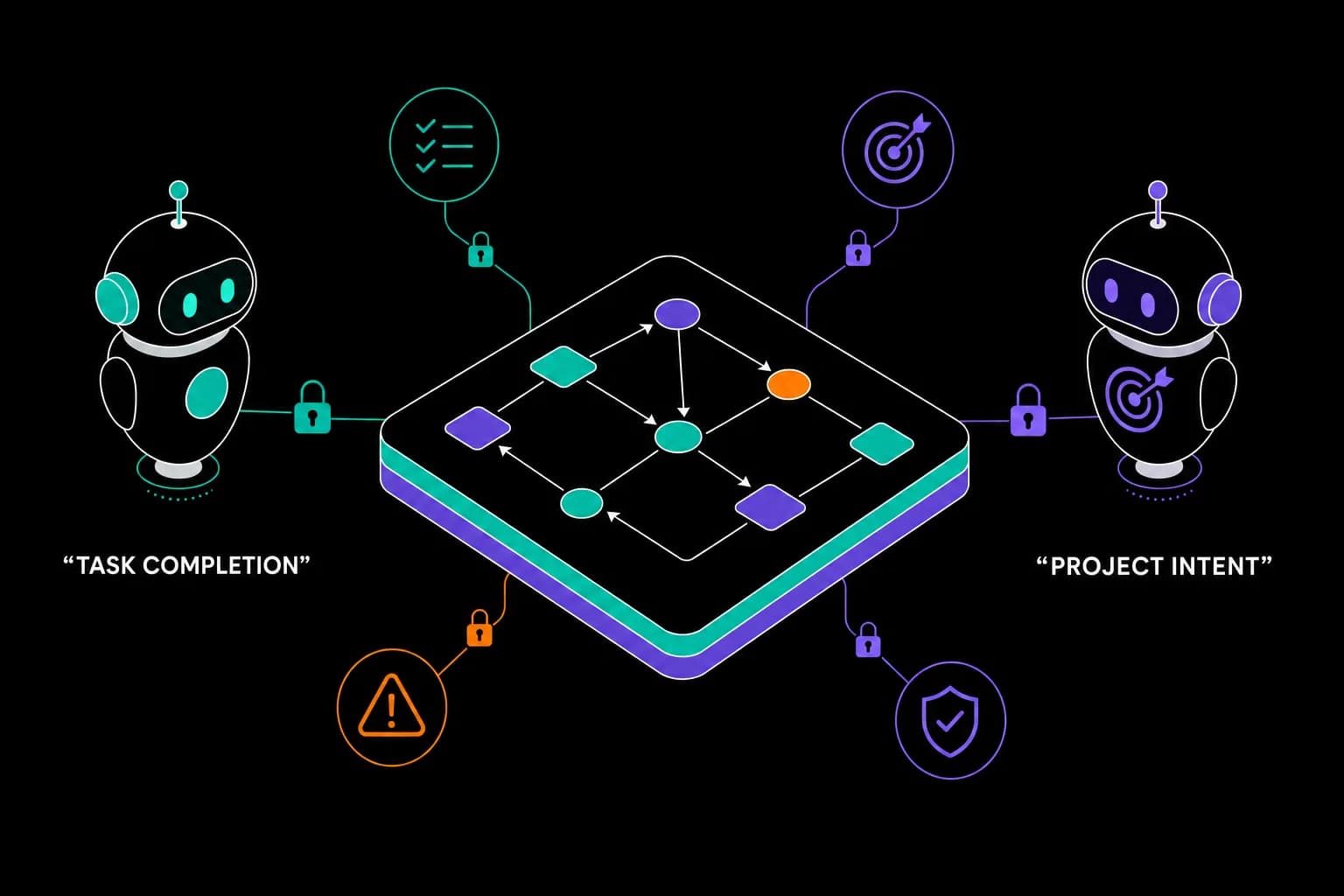
In short: Task Completion, Harness Design, and Project Intent. Once those layers are separated, tools that solve different problems no longer look like direct substitutes. Whether work is ultimately carried out by a person, Pi, DeepSeek Harness, or another agent is secondary to project steering. What matters is that the work serves the project goal and its result returns to project context.
Not to be confused, HERMES: Searches for "Hermes project management" often mean the Swiss HERMES method (eCH-0054), an established project management methodology used by Swiss federal administration. That is a methodology with scenarios, roles, and certification, not software, and not an AI agent. This article is exclusively about the Hermes Agent by Nous Research.
Task Completion, Agent Runtime, or Project Control?
In short: OpenClaw and Hermes organize concrete instructions and recurring workflows. Pi and DeepSeek Harness give technical agents models, tools, sessions, and runtime logic. TensorPM adds a living project context and supports evaluating which work moves the project forward. The difference is purpose, not feature set.
All three tools provide chat as the default interface. All three can execute tasks: read web pages, run skills, write files, call external APIs. Comparing along those axes yields nothing. The comparison only becomes meaningful once you ask what the agent is optimizing for:
| Question | OpenClaw / Hermes Agent | TensorPM |
|---|---|---|
| Lead question | "How do I complete this task?" | "Which task moves the project forward?" |
| Success metric | Task done, workflow ran | Project stays on track across timeline, budget, and scope |
| Who executes? | The agent | Human or agent, secondary: as long as it gets done correctly within the project |
| Context | Helps with execution | Carries the project intent |
| Memory | What worked, what is known? | Why are we doing this project, where do we stand, what follows? |
| Role in the project | Operational execution | Context layer for project steering, extended by bounded execution |
| Project graph | Not central | Means for sustained intent-keeping, not an end in itself |
TensorPM doesn't simply differ by having more context. Context and the project graph are means. The difference lies in what the agent is optimizing for. OpenClaw and Hermes can complete tasks inside a project. TensorPM helps evaluate which tasks are relevant in the first place, who is affected, which decision could follow, and whether the project gets closer to its goal.
An example: three emails come in. One is a newsletter, one is a client amendment to the steel-and-concrete lump sum, one is a sales pitch. An agent that sees only the immediate instruction might process all three by the same logic: extract, file, maybe turn into a task. TensorPM first checks the messages against the confirmed project context and proposes which of them changes project intent. Newsletter and pitch fall outside the closer project review. The amendment becomes a decision proposal with reference to the affected trade, budget line, and deadline, plus a derived action that, depending on content, lands with the project controller, the architect, the subcontractor, or the agent itself. The action follows project logic, not technical possibility. Who carries it out depends on who can do it best.
TensorPM's role
This focus gives TensorPM a clear role: current, confirmed context is the foundation; project analysis and guidance are the core; concrete execution extends both where it serves the project. AI can perform or propose research, distillation, preparation, and skill execution. Accountable people confirm context changes and decide on consequential changes to timeline, budget, scope, and authority.
TensorPM: Project Context as the Carrier of Intent
TensorPM connects operational execution with context-based guidance for project steering. The project graph is its memory, but not its purpose. It is designed to keep project intent traceable across weeks, months, and multiple stakeholders, and to derive proposals for work, decisions, risks, and communication from that intent.
At the center sits a local-first project graph with goals, requirements, success criteria, risks, milestones, decisions, owners, budgets, action items, and audit trail. This structure is more than a database. It holds goals, decisions, and risks together so the agent can track project intent over time.
The TensorPM agent can execute web research, browser sessions, sandboxed skills, calendar proposals, and the creation or revision of Word documents, PDF reports, and presentations. It can assign technical action items directly to Codex or Claude Code and follow the run interactively or headlessly. Execution remains embedded in the project view; tool calls, context proposals, and decisions appear in the activity trail.
The surfaces are three:
First, a desktop app for humans with classical PM UI: lists, kanban board, Gantt timeline, recurring items, dependencies, budget, files with AI summaries, plus a chat interface to the built-in agent. The chat is standard, like everywhere else. The difference: every conversation is embedded in the project graph.
Second, an open agent interface via MCP and A2A. External agents such as Claude Code, Codex, OpenClaw, or Hermes can read and write the same project graph instead of having the context re-explained at every session. TensorPM provides the project context that other agents can hook into, rather than competing with them.
Third, a messenger channel via Telegram (WhatsApp is not currently supported) with roles and visibility configurable per participant. The client, the architect, the subcontractor, the project controller: everyone with access to the channel can see different parts of the project graph and trigger different actions. Inbound messages run through the same relevance filter as any other signal. The TensorPM agent becomes a multi-stakeholder project channel rather than a workspace daemon serving a single user. It is reachable as long as the TensorPM app runs on the project owner's PC; always-on hosting in a datacenter is not part of the architecture, because project data is meant to stay local.
Local-first and without a permanent agent gateway: TensorPM is not 24/7 bot infrastructure in a datacenter. All project data lives in a local database on the user's machine. The agent doesn't open external integrations on its own. Telegram is the only inbound messenger channel; outbound, only web search and browser steering. Anything else must be explicitly enabled by the user through MCP or A2A connections. Optional Cloud Sync replicates projects between authorized devices and workspace members; what travels through the network is encrypted project content, while the metadata necessary for sync, roles, invitations, and billing remains visible (workspace names, members, IDs, timestamps).
The agent can schedule future runs and reminders from a conversation. That does not turn TensorPM into a permanent cloud daemon: scheduled and interactive execution remains tied to the local desktop runtime and its permission boundaries.
Distillation runs with the user's confirmation. The agent prepares proposals (action items from a document, decision proposals from an email, context updates from a meeting), shows them in the distiller, and waits for approval. Autonomous drift becomes much harder, because the project graph is not changed without sign-off.
Skills and workflows are integrated as explicit capabilities with instructions and resources. Unlike a silently learned and activated routine, the capability being used and the tools or permissions it needs remain visible.
AI backend: Multi-provider, TensorPM-hosted AI through Trial/Pro/Business, Business BYOK, and local models through Ollama, LM Studio, or vLLM. Claude and ChatGPT subscriptions can connect through the local Claude Code and Codex runtimes.
Strength: The project as memory and steering model. Relevance filtering, analysis and guidance, concrete artifacts, direct delegation to coding agents, a multi-stakeholder Telegram channel, local-first storage, and open MCP/A2A access.
Limit: No 24/7 server daemon. The agent is only reachable while the desktop app runs. Anyone who needs a permanently online bot across several messenger platforms combines TensorPM as a context layer with OpenClaw or Hermes as a frontend.
OpenClaw: All-Purpose Personal Agent with Session Memory
OpenClaw is an MIT-licensed personal agent framework by Peter Steinberger (previously PSPDFKit). The frame of reference is sessions and workspaces, not a methodical project graph.
Architecturally, OpenClaw is a long-running agent daemon that attaches to the messengers the user already uses: WhatsApp, Telegram, Slack, Discord, Signal, iMessage, Microsoft Teams, Matrix, and more. Multiple agents can run in parallel per workspace, each with its own sessions and skills.
Memory lives as editable note files in the workspace and remembers users, available tools, and learned preferences, but not a concrete project with goals, risks, and stakeholders. That's workspace memory, not project memory.
Multi-channel reach is broad, but conceptually a single trust boundary: one agent per workspace, tied to one operator and their accounts. Multiple people can talk to the same gateway, but project-bound roles and fine-grained visibility don't exist; every message is served within the operator's trust model.
For project management there is the Clawdbot template, a preconfigured agent for task coordination, which can access thousands of skills via the ClawHub registry (integrations for Linear, GitHub Issues, Jira, arbitrary REST APIs). No project graph emerges from that; OpenClaw delegates structuring to the external tools.
Strength: Broad integration ecosystem and strong messenger coverage, including WhatsApp, Telegram, Discord, Slack, Signal, and iMessage. Native multi-agent orchestration. Well suited to power users with many channels who need a permanently online daemon for operational automation.
Limit: Security discipline is mandatory. In early 2026, Koi Security audited the ClawHub skill registry of the time and found hundreds of malicious entries, most from a single coordinated campaign. Microsoft's own security blog recommends treating OpenClaw as "untrusted code execution with persistent credentials" and not running it on regular workstations. Structurally: no project graph, no methodical relevance filter, no PM UI.
Hermes Agent: Self-Improving Execution for Recurring Tasks
Hermes Agent by Nous Research launched in February 2026 and is among the fastest-growing open-source agent projects of 2026 (six-figure GitHub stars as of early summer). Open source, deployment on the user's own infrastructure.
The defining mechanism is the closed learning loop. When the agent finishes a task, it analyzes its steps, identifies recurring patterns, and after several similar tool calls automatically generates a skill. These become slash commands. That is the task-learning mechanism OpenClaw does not have.
Whether that is a strength or a risk depends on the use case. Anyone who wants predictability and auditability in their skill set must invest more discipline with Hermes than with TensorPM, where skills are deliberately human-driven.
Persistent memory is the second defining feature: a curated memory set loaded into the system prompt at session start, complemented by plugin connections for semantic search. Same caveat applies: it is a memory of workflows and preferences, not a memory of a concrete project with goals, risks, budget, and stakeholders.
For PM-adjacent workflows Hermes ships its own kanban board, persistent and usable via CLI, slash command, or dashboard. "Digital twins" are named specialist agents (for example for inbox triage or ops review) that accumulate memory over time. In multi-agent mode an orchestrator decomposes tasks automatically and a swarm pulls them off the board. Vendor-adjacent reviews report 40% faster task completion; that number should be cited with caution.
Hermes runs as a daemon on its own infrastructure and is reachable across several messenger platforms, even when nothing at the user's workstation is open.
Strength: Self-learning skills that improve with use. Clear kanban mechanics with multi-agent extension. Approval system and multiple container backends ship out of the box.
Limit: The agent remembers workflows, not projects. No full project graph with goals, success criteria, risks, decisions, budget. The kanban board is a task collection, not a methodical project context. For classical PM discipline (reference-class forecasting, decision logs, budget tracking, stakeholder management), additional tooling has to run alongside.
Pi: The Deliberately Minimal Agent Harness
Pi does not describe itself as a project management agent. It is a minimal terminal harness for coding agents. That distinction matters. Pi does not aim to prescribe a large set of finished features. It provides a small, inspectable core that users adapt through TypeScript extensions, skills, prompt templates, themes, and installable packages.
The core supports more than 15 providers and hundreds of models. A user can switch models during a session. Sessions are stored as trees, so users can return to an earlier point, continue in another direction, and keep both branches in one file. While the agent works, steering messages can be delivered after the current tool call. A follow-up can instead wait until the run finishes.
Pi offers four operating modes: an interactive terminal UI, print or JSON for scripts, RPC over stdin and stdout, and an SDK for embedding Pi into other applications. OpenClaw is a real-world example of that embedding. Pi is therefore less a finished workplace and more a component from which other agent products can be built.
What Pi deliberately omits says almost as much as what it includes. The core has no MCP, subagents, permission popups, plan mode, built-in todo management, or background bash. All of these can be added through extensions, packages, external CLI tools, or containers. Experienced developers may value a harness that does not dictate their workflow. Teams without harness expertise inherit additional architecture work.
For project management, Pi is a possible technical executor. A well-specified action item can be implemented in a Pi session. Pi does not hold budget, stakeholders, risks, or project intent. Its security boundary is not automatic either. Teams that need approvals, path protection, or sandboxing must add them deliberately.
Strength: Small, inspectable core. Extensive customization. Model switching inside a session. Tree-structured history, runtime steering, SDK, and RPC. Well suited to teams that want to own their agent harness.
Limit: Many capabilities that other products ship as defaults must be built or installed. No built-in project graph, PM model, or mechanism for returning agent outcomes to project steering.
DeepSeek Harness: Everything Is a Plugin
DeepSeek Harness, or dsh, is DeepSeek's own open-source agent harness. It entered developer preview in August 2026 under the MIT license. DeepSeek explicitly warns that compatibility-breaking changes are coming. For production procurement today, it is better understood as an architectural bet than a finished standard.
Its central idea is that every capability is a plugin. Models, tools, skills, sessions, sandboxes, storage, agent loops, scheduling, and the UI can be selected, swapped, or recomposed. The Cordis kernel only manages plugin mounting, removal, and dependencies. Agent capabilities live outside the kernel.
DeepSeek Harness ships several runtime modes. Standard Mode is a full coding agent with file and web search, shell, planning, goals, subagents, and workflows. Code Mode also exposes tools through a TypeScript SDK so the model can orchestrate multi-step tool calls inside one program. Minimal Mode reduces the agent to persistent bash and a file editor. Creator Mode is designed for building and testing new presets and plugin combinations inside the running system.
Its second strong idea is the event trail. Everything the model sees is recorded in an append-only session log: system prompts, reasoning, tool calls, results, subagent scheduling, and context injections. Search, resume, fork, and replay all operate on the same event stream. The harness is therefore not only composable, but reconstructable.
By default, dsh starts as a local web interface and works inside an explicitly selected workspace. DeepSeek says prompts, model outputs, tool calls, paths, and runtime logs are stored locally first. External models, web tools, MCP servers, and plugins can still send data to their respective providers. Because the harness executes code locally, DeepSeek explicitly recommends a dedicated VM or container, human approval for consequential actions, and only reviewed plugins, skills, and MCP servers.
DeepSeek Harness is not a project management system either. Its frame of reference is the technical agent runtime. A plugin could provide project context or return outcomes to a PM system. That connection is configuration or development work, not a built-in project model.
Strength: Consistent plugin architecture, several runtime modes, a complete event trail, local web UI, and Creator Mode for composing agent presets. Interesting for platform teams building their own agent runtime.
Limit: Developer preview with announced breaking changes. Broad local action scope and a plugin supply chain require a deliberate security architecture. No project graph, stakeholder model, or methodical project steering.
Sparse Attention Meets a Growing Event Log
This creates an interesting architectural tension. DeepSeek V4 reaches its one-million-token context window through token-wise compression and DeepSeek Sparse Attention. Sparse attention lowers compute by avoiding detailed attention from every new token to every old token. An indexer selects the parts of history that appear relevant to the current query.
DeepSeek Harness simultaneously treats an append-only event log as the durable truth of a session. System prompts, messages, reasoning, tool calls, results, subagents, and context injections remain recorded. Model history is derived from that log. As an agent works longer, the potential haystack containing one small early fact keeps growing.
The tempting punchline is that DeepSeek built a harness that encourages long histories while its own models use sparse attention to decide which old regions deserve detailed attention. The evidence is more complicated.
DeepSeek explicitly markets V4 as a long-context model. The current 0731 checkpoint was also evaluated on agent benchmarks using DeepSeek Harness Minimal Mode. Independent measurements show successful needle retrieval beyond one million tokens when the sparse indexer is implemented correctly. A recent vLLM ROCm bug shows the opposite risk: in that specific backend configuration, retrieval dropped from three successful needles to zero between roughly 3,600 and 5,300 tokens. The issue points to the implementation's sparse-indexer path, not to a proven universal model failure.
The defensible claim is narrower. Sparse attention makes long context cheaper, but reliability depends more heavily on the indexer, inference backend, quantization, and the shape of the information being retrieved. Needle-in-a-haystack research also shows across model families that short, fine-grained facts among many distractors are harder to recover than larger relevant passages.
DeepSeek Harness addresses context growth through compaction. Older regions can be replaced with a summary while the complete event log remains available for replay and audit. That is better than sending the full raw trajectory into every model request. It shifts risk to the summary, however. Anything omitted there must later be recovered through search, replay, or targeted context injection.
The implication for long-running project work is clear. An append-only log is a strong evidence trail, but not a substitute for structured memory. Critical goals, decisions, risks, and commitments should not live only somewhere in a growing session. They need addressable, typed records that a harness can bring into the active context deliberately.
When a Model Benchmark Names the Harness
The DeepSeek-V4-Flash-0731 model card contains a notable methodology note. DeepSeek does not only identify the model behind the score. For code-agent benchmarks, it also names the agent framework: DeepSeek Harness Minimal Mode, max reasoning effort, temperature 1.0, and top-p 0.95.
This makes visible what often disappears into benchmark footnotes. A score does not belong to a model alone. It belongs to a combination of model, harness, tools, prompt, context management, stopping logic, permissions, and evaluation environment.
This is not normal practice today. Commercial model releases usually show a model name and a score. The harness remains unnamed, is described only as an internal scaffold, or is not available outside the vendor at all. Recent work on the scaffold effect criticizes exactly this under-specification.
There are earlier counterexamples. OpenAI system cards have described internal tool scaffolds used for agent evaluations. Google's Gemini 2.5 Pro model card explains its own multi-attempt scaffolding for SWE-bench and explicitly warns that provider-reported numbers use different scaffolds and infrastructure. These disclosures often remain abstract, however. The exact harness is commonly internal, not installable, and not inspectable as a standalone runtime.
DeepSeek's step is therefore more than another footnote. The company releases the model and its own open-source harness together, names the exact harness mode in the model card, and adds important inference settings. Other developers can inspect the runtime, study the configuration, and reproduce parts of the setup.
It would not be defensible to call this the first harness disclosure in any AI benchmark. It is still a genuine novelty in current major-model release practice: a vendor makes its own publicly available harness and exact mode a visible component of the model result. That remains very rare.
Harness-Bench and work on the scaffold effect now treat model-harness pairs explicitly as the real evaluation unit. Their results show that harness choice can materially change pass rate, token use, latency, and failure patterns. For agentic work, a model ranking without a harness description is methodologically incomplete.
ProjectBench follows this principle from the start. We do not measure how a model answers an isolated prompt. We measure how it works inside the real TensorPM product with the project graph, tools, approvals, replanning, and blind judging. The harness stays fixed across model comparisons. That makes it easier to see which part of plan quality comes from the model and which comes from structured project context and product workflow.
The parallel matters. DeepSeek makes the harness visible in coding benchmarks. ProjectBench makes project context and the real PM system visible. Both approaches shift the question from "Which model is best?" to "Which model-harness system creates the most value under these conditions?"
Claude Code and Codex as Optional Product Runtimes
DeepSeek Harness can expose Claude Code and Codex as subagents. Technically, it does not do this by loosely calling an existing host installation. The optional provider bundles each bring a private, pinned product runtime.
The Claude bundle depends on the official @anthropic-ai/claude-agent-sdk and its native platform packages. The SDK selects the bundled Claude Code executable. There is no fallback to a claude command on the normal PATH. The Codex bundle depends on the official @openai/codex package and launches its pinned wrapper and platform payload. It does not fall back to a host codex either.
The installation boundary matters. A normal @deepseek-ai/dsh install contains neither provider nor product runtime. The relevant binary payload is downloaded only when a user installs one of the optional Profile Bundles. The bundle then registers a dormant provider. Claude Code or Codex starts only on the first actual delegation.
For Codex, the licensing position is comparatively straightforward because the official package is Apache 2.0. The Claude Agent SDK and native Claude Code payloads are not governed by simple MIT terms. Anthropic's Commercial or Consumer Terms and the package-specific license apply. Anthropic expressly allows customers to preinstall or run the unmodified Claude Code binary in a product under stated conditions. Authentication methods may not be removed or restricted. Every end user must authenticate with their own Anthropic, cloud-provider, or API credentials and be billed under their own agreement. Branding must not imply an Anthropic partnership or endorsement.
DeepSeek Harness documents this separation in its Third-Party Notices and lists the Claude Code platform packages with versions and declared license fields. The notices also say that the project owner authorizes distribution of the official payloads. That is a compliance statement from the project, not independent evidence of a separately negotiated license with Anthropic.
The integration is therefore not automatically unlawful. It creates an ongoing compliance obligation. With every update, DeepSeek must verify that the binary, wrapper, package terms, authentication flow, branding, and notices still align. Any company redistributing DeepSeek Harness or offering it as a managed service should make that review part of production due diligence. This is not legal advice, but it is a concrete compliance question.
Where the Agent Lives: Desktop App vs. Cloud Daemon
In short: TensorPM runs as a desktop app on the project owner's PC, reachable while the app is open, which keeps project data local. OpenClaw and Hermes run as daemons (own machine, VPS, or cloud) and stay reachable around the clock. The hosting form alone already decides what the agent is good for.
An axis missing from most comparisons because it slips past as a detail: where does the agent actually live?
TensorPM is a desktop app on the project owner's PC. That is deliberate, not a gap. There's a shared workspace: kanban, Gantt, budget, files, trail. That UI belongs to the agent, not as a bolted-on dashboard, but as the place where human and agent see and edit the same objects. A pure server architecture without local UI would dissolve that interplay. The agent is only reachable while the app runs; in exchange the working context stays local, with an optional end-to-end encrypted Cloud Sync.
OpenClaw and Hermes are daemons that can run anywhere: on a second machine at home, on a VPS, in the cloud, or in a Docker container alongside other services. They are built to be reachable around the clock, with no human endpoint required. Anyone who needs a permanently online Telegram, WhatsApp, or Slack bot chooses this architecture, not a desktop app.
Pi normally runs as a terminal process in the current project directory. For long-running processes, the project deliberately points users to tmux instead of shipping a built-in background service. RPC and the SDK can still embed Pi inside another application or a custom daemon.
DeepSeek Harness starts as a local web interface by default. A user must select a workspace before running the first task. Scheduling exists as a plugin capability, but dsh is fundamentally a local agent runtime, not a finished hosted 24/7 messenger service.
These are not the same market. Anyone who needs a bot online around the clock in a messenger needs a different architecture than someone steering a project in a shared workspace. The hosting form already settles the application model.
Access and Transparency: Five Different Security Models
In short: TensorPM constrains the action space inside the product. Hermes ships approvals and container backends. OpenClaw places substantial trust in the operator by default. Pi deliberately leaves permission gates and sandboxing to extensions or containers. DeepSeek Harness provides approval policies and sandboxes as plugins, but still recommends a dedicated VM or container for real use.
An aspect missing from most comparisons because it stays invisible until something goes wrong: what access does the agent have to the system, and can the user see afterwards what it did?
TensorPM limits access more strongly at the architecture level than classical daemon agents. The agent has no shell access. Its field of view ends at the project folder. Permitted actions are web search, browser interactions via a controlled profile, skills in a sandbox with networking disabled by default, and whatever is enabled through configured MCP or A2A connections. The agent doesn't open external integrations on its own; connected sources and interfaces have to be configured explicitly. Sources that haven't been configured don't enter the context automatically. Every agent action lands in the project's trail: what was done when, with what justification, with what result. The user can see what action was triggered and why.
OpenClaw is designed around the "single trusted operator" trust model. Its official documentation describes the default as host execution at full security level with no confirmation prompt, intended for a single operator who trusts their agent. In this default mode, the agent can run arbitrary shell commands, read and write files, use network services, send messages. Multi-tenant or hostile multi-user scenarios are explicitly not the design goal. Microsoft published a security blog in February 2026 classifying OpenClaw as "untrusted code execution with persistent credentials" and advising against deployment on regular workstations. In early 2026, OpenClaw was investigated intensively; besides publicly discussed vulnerabilities, the skill supply chain came under particular scrutiny. Koi Security found 341 malicious skills in a ClawHub audit, 335 of them from a coordinated campaign. Anyone running OpenClaw in production builds the security discipline themselves: skill whitelisting, sandbox wrappers, separated identities, container isolation.
Hermes Agent combines shell access with an explicit approval and isolation model. By design the agent has shell access via the terminal tool, but Nous Research ships an approval system that gates terminal commands, file operations, and destructive actions behind explicit user confirmation. Multiple terminal backends allow execution to be offloaded into containers. The documentation honestly notes configuration switches that disable this security boundary for production. The first CVEs for Hermes were publicly listed in spring 2026, covering path traversal, symlinks, and injection topics. This does not automatically make Hermes less secure than OpenClaw. It shows that Hermes, like any tool-capable agent system, needs a real security model. The official security policy honestly states that the only effective boundary against an adversarial LLM is OS-level isolation, not approval gates, tool allowlists, or pattern scanners.
Pi has no permission popups in its core. This is not an overlooked feature, but part of the philosophy. Users are expected to choose the appropriate boundary through extensions, path protection, Gondolin, Docker, OpenShell, or another container layer. Pi stays small and flexible. The operator remains responsible for deciding whether it runs on the host, inside a project container, or behind custom approval rules.
DeepSeek Harness can edit files, run shell commands, delegate to subagents, and connect more systems through plugins. The Web UI asks before actions that require approval under the active permission policy. DeepSeek still recommends a dedicated VM or container, small isolated tasks, human approval for consequential actions, and only reviewed plugins, skills, hooks, and MCP servers. The complete event trail improves auditability, but does not replace isolation.
In practice, TensorPM builds a narrower action radius into the product architecture. With OpenClaw, Hermes, Pi, and DeepSeek Harness, the operator shapes the real boundary more directly through gateways, plugins, credentials, approvals, and OS isolation. Platform teams can manage that. In regulated industries it becomes an architecture topic of its own.
Project Secrets and Data Sovereignty: Who Gets to Hold the Project Memory?
In short: For self-operated harnesses, privacy depends not only on the local process, but also on the selected model, plugins, and connected services. Pi and DeepSeek Harness can run locally, but external providers still receive the data sent to them. TensorPM additionally ties data authority to project-bound, human-confirmed context.
For project management agents, privacy is not just a hosting question. In practice, the question is which agent gets to see and store project communication, budget figures, contract amendments, and open decisions over time. This is where the difference between broad operational execution and deliberately bounded, project-specific context becomes practically relevant.
OpenClaw can be operated in a privacy-conscious way, but the GDPR architecture sits with the operator. Its official privacy documentation makes clear that app data goes to the gateway the user chose and that the practices of that gateway, the LLM provider, and connected services are not covered. Anyone setting up a clean EU deployment with Azure OpenAI or comparable routing can solve that productively; privacy here is operator discipline, not a product promise.
Hermes Agent is likewise self-hosted and thus controllable. There is no explicit GDPR or EU-residency commitment. What there is: technical building blocks such as opt-in PII redaction (not on all platforms), retention configuration, container isolation, and approval modes. By default, session history is not pruned automatically, because the self-learning loop needs memory. From a GDPR perspective this is exactly where purpose limitation and deletion strategy must be clearly defined.
Pi stores its tree-structured session history locally and can call local or self-hosted models. Its multi-provider architecture also means the privacy terms of the selected provider apply. Long-term memory, RAG, and external tools arrive through extensions and bring their own data flows.
DeepSeek Harness says prompts, model responses, tool calls, paths, and runtime logs are stored locally by default. Telemetry can be disabled or redirected. Once an external model provider, web tool, MCP server, or plugin is enabled, that service may transfer data. Local-first describes the harness, not automatically the complete processing chain.
TensorPM keeps the project memory local-first and project-bound. By default the agent does not see the whole PC, only the project folder that gets distilled, plus the sources the user has actively connected (mail accounts, MCP/A2A connections). Anything else only enters the context through explicit interaction or configuration. Outbound stays web search and browser steering. Optional Cloud Sync E2E-encrypts project content; the visible metadata (workspace, members, IDs, timestamps) were noted above.
What matters is context sovereignty: which information becomes durable project memory and who may change it? OpenClaw, Hermes, Pi, and DeepSeek Harness optimize different forms of execution. TensorPM is designed to admit only confirmed, project-relevant information into the shared graph. Model choice, connectors, and endpoint security still matter there too. Project content, approval, and data minimization are coupled more tightly.
Direct Comparison
Role in the Project
| System | Primary frame | What it does especially well | What project steering still needs |
|---|---|---|---|
| TensorPM | Project and project intent | Context, analysis, guidance, governance, PM interface | No permanent 24/7 cloud daemon |
| OpenClaw | User, workspace, channels | Messaging, integrations, persistent general automation | No methodical project graph |
| Hermes Agent | Session and workflow | Recurring tasks, self-learning skills, kanban | No full model for goals, budget, and risks |
| Pi | Terminal session, codebase | Minimal, customizable multi-model harness | PM context and governance must be added |
| DeepSeek Harness | Workspace, agent runtime | Plugin runtime, subagents, modes, event replay | PM model and production maturity are missing |
Architecture and Operations
| System | Default surface | Extension model | Security boundary | License / maturity |
|---|---|---|---|---|
| TensorPM | Desktop PM app | Skills, MCP, A2A, connectors | Product boundaries, approvals, project visibility | Proprietary, production |
| OpenClaw | Messenger, gateway | Community skills and integrations | Operator hardens host, credentials, and skills | MIT, production-capable |
| Hermes Agent | CLI, messenger, dashboard | Skills, plugins, container backends | Approval system and selected terminal backend | Open source |
| Pi | Terminal | Extensions, skills, packages, RPC, SDK | Operator-selected extensions and containers | MIT |
| DeepSeek Harness | Local web UI | Everything as a Cordis plugin | Permission policy, plugins, VM or container recommended | MIT, developer preview |
Which Agent When?
In short: OpenClaw fits cross-channel 24/7 automation. Hermes fits recurring workflows with self-learning skills. Pi fits a small, self-shaped terminal harness. DeepSeek Harness fits platform teams composing a plugin runtime. TensorPM fits methodical steering of an overarching project.
OpenClaw and Hermes optimize task completion. Pi and DeepSeek Harness optimize the technical runtime in which a model performs such work. TensorPM optimizes project steering: which work matters, in what order, with which risk, and under whose authority.
Seven typical situations:
"We manage a ten-million-euro construction project with 60 participants over two years." TensorPM. At that scale the question is not "who handles the next email?" but "where do we stand, what is at risk, which decision is coming?". Those questions require a project graph maintained reliably across weeks and months, with audit trail and methodical relevance filtering. Hermes and OpenClaw aren't wrong here, but they sit one level too low.
"We want the client, the architect, the subcontractor, and the project controller to talk to the agent over Telegram, each with their own role and visibility." TensorPM. The Telegram channel is built exactly for this multi-stakeholder mode: each person with their own role, their own read/write rights on parts of the project graph, their own permitted actions. The prerequisite is that the TensorPM desktop app runs on the project owner's machine; an always-on bot in a datacenter is not part of the architecture. OpenClaw and Hermes do cover more channels (including WhatsApp), but they are conceptually single-user agents: the agent belongs to the account holder, project-bound role distribution doesn't exist.
"We want a 24/7 all-purpose daemon that reacts on WhatsApp or Signal regardless of the workstation." OpenClaw. The always-on gateway approach, the wide messenger coverage, and the self-hosted architecture are built for this. Security discipline (skill whitelisting, permissions, container isolation) is mandatory.
"We have a weekly rhythm of standups, reports, and retros that should improve over time, and we don't mind that the agent autonomously generates skills." Hermes Agent. The self-learning loop generates reproducible slash commands from patterns, the cron scheduler triggers, the kanban keeps tasks persistent. Anyone who wants every new skill to be deliberately written and approved by a human is better served by TensorPM.
"We want a transparent terminal agent whose workflow and model choice we control ourselves." Pi. The small core, tree-structured history, and extensions suit teams that want to shape their own harness. They must deliberately add sandboxing, MCP, subagents, and permission gates.
"We are building an internal agent platform with swappable tools, sandboxes, models, subagents, and our own UI." DeepSeek Harness. Cordis and the capability seams are designed for exactly this kind of composition. Developer preview status, breaking changes, local code execution, and optional bundled third-party runtimes mean production use needs dedicated security, license, and upgrade governance.
"We want an agent to turn incoming emails into structured action items and decision proposals, assigned correctly to the project, with human confirmation." TensorPM. This is exactly the distillation workflow the platform is built for: mail connector, relevance filter against the project graph, proposal structure, human-in-the-loop approval, mutation of the graph with audit entry.
It's Not Either/Or
Because TensorPM exposes MCP and A2A, an OpenClaw agent on WhatsApp or a Hermes agent in a scheduled job can read the TensorPM project graph and submit proposals. Pi has no MCP in its core, but can connect through an extension, CLI tool, or SDK. DeepSeek Harness can compose such a connection as a plugin or MCP integration. For Pi and DeepSeek Harness, this is currently integration work, not a finished TensorPM delegation path.
In that architecture, TensorPM holds confirmed project context. OpenClaw and Hermes organize channels and recurring workflows. Pi or DeepSeek Harness can perform specialized technical work. No one system needs to own every role.
That is the idea behind Context-Driven Project Management (CDPM): not the one agent that replaces everything, but a common, cleanly structured project context that every agent and every human can access. The method delivers the "how," the context layer delivers the shared memory.
Conclusion: Task Completion or Project Intent?
The choice between TensorPM, OpenClaw, Hermes, Pi, and DeepSeek Harness depends on which layer is missing.
Teams seeking execution across many channels should look at OpenClaw. Teams that want recurring workflows with self-learning skills should look at Hermes. Teams that want a small, controlled terminal harness should evaluate Pi. Teams building a complete plugin-based agent platform, and able to carry developer-preview risk, should evaluate DeepSeek Harness.
Anyone seeking project control, meaning an overarching project with multiple stakeholders in clear roles, methodically maintained, where project intent has to be tracked over time, is well served by TensorPM. The lead question shifts from "how do I complete this task?" to "which task moves the project forward without putting timeline, budget, or scope at risk?". Who executes, human or agent, depends on who can do it best. Context changes remain subject to review; execution tools work within defined permissions and their actions remain traceable.
In many project organizations, the productive answer will be a combination: TensorPM as the context and steering layer, OpenClaw or Hermes for channels and recurring workflows, and Pi or DeepSeek Harness for specialized technical execution. Not every integration path is finished today, but the layers can be separated cleanly.
For anyone who wants to test the difference on a real project: TensorPM is available as a desktop app for Windows, macOS, and Linux. The no-time-limit Trial includes Cloud Sync and 2,000,000 lifetime credits; alternatively, the app can run locally without an account and with local models. BYOK/API-key management is part of Business.
Corrections
No corrections to date.
Sources
- TensorPM: Context-Driven Project Management (TensorPM)
- TensorPM Security & Privacy (TensorPM)
- OpenClaw: Official Docs (OpenClaw)
- OpenClaw Privacy Policy (OpenClaw)
- Hermes Agent: Nous Research (Nous Research)
- Hermes Agent Security Docs (Nous Research)
- Hermes Agent Configuration (redact_pii) (Nous Research)
- Hermes Agent SECURITY.md (GitHub / Nous Research)
- Kanban (Multi-Agent Board): Hermes Agent Docs (Nous Research)
- HERMES Project Management Method (eCH-0054) (Swiss Federal Administration)
- NVD CVE-2026-7396: Hermes Agent (NVD)
- NVD CVE-2026-7397: Hermes Agent (NVD)
- Koi Security: ClawHub Audit (341 malicious skills) (Koi Security)
- Running OpenClaw safely: identity, isolation, and runtime risk (Microsoft Security Blog)
- Four OpenClaw Flaws Enable Data Theft, Privilege Escalation, and Persistence (The Hacker News)
- OpenClaw Security Risks: From Vulnerabilities to Supply Chain Abuse (Sangfor)
- OpenClaw vs Hermes Agent: The best agent harness in 2026 (Composio)
- What is OpenClaw? (DigitalOcean)
- Pi Coding Agent (Pi / Earendil)
- Pi Documentation (Pi / Earendil)
- What I learned building an opinionated and minimal coding agent (Mario Zechner)
- DeepSeek Harness: Everything is a plugin (DeepSeek)
- DeepSeek Harness Developer Documentation (DeepSeek)
- DeepSeek Harness Source Code (DeepSeek / GitHub)
- DeepSeek Harness Safe Use Policy (DeepSeek)
- DeepSeek Harness Data Processing Statement (DeepSeek)
- DeepSeek V4 Preview: Sparse Attention and 1M Context (DeepSeek)
- DeepSeek-V4-Flash-0731 Model Card (DeepSeek / Hugging Face)
- DeepSeek Harness Sessions: Append-only Event Log (DeepSeek / GitHub)
- DeepSeek Harness Compaction (DeepSeek / GitHub)
- vLLM Issue 52109: ROCm Sparse Indexer Retrieval Corruption (vLLM / GitHub)
- Measured DeepSeek V4 Flash Long-Context Results (Independent implementation report / GitHub)
- Lost in the Haystack: Smaller Needles are More Difficult for LLMs to Find (arXiv)
- Production dsh excludes product subagent providers (DeepSeek / GitHub)
- Product subagent providers live in the shared profile host (DeepSeek / GitHub)
- DeepSeek Harness Third-Party Notices (DeepSeek / GitHub)
- Claude Code Legal and Compliance (Anthropic)
- Gemini 2.5 Pro Model Card (Google)
- ChatGPT Agent System Card (OpenAI)
- The Scaffold Effect in Coding Agents (arXiv)
- Harness-Bench: Measuring Harness Effects across Models (arXiv)
- ProjectBench: The Model Matters Less Than the Context (TensorPM)